
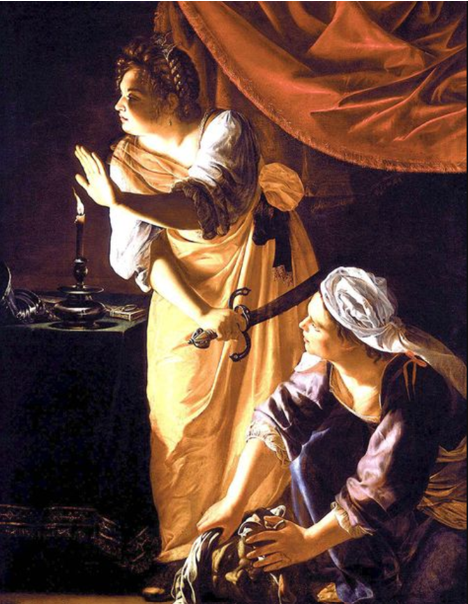
Before women were permitted to easily enter academies, command studios, or build celebrated careers as painters, Artemisia Gentileschi was creating women who refused to be powerless.
Born in Rome in 1593, Gentileschi became one of the most accomplished painters of the Italian Baroque period.
And yet, for centuries, her name existed in the shadow of the men around her.
She learned to paint in the studio of her father, Orazio Gentileschi, developing extraordinary skill in dramatic composition, light, shadow, and the emotional intensity that defined Baroque painting.
But Artemisia painted women differently.
In her work, women were not simply beautiful objects waiting to be observed.
They acted.
They resisted.
They survived.
They fought back.
Her paintings frequently depicted powerful women from biblical and historical stories—Judith, Susanna, Cleopatra, and others—giving them a physical presence and psychological depth rarely afforded to female subjects.
Perhaps her most famous work, Judith Slaying Holofernes, is impossible to ignore.
Judith does not hesitate.
She is not delicate.
She is not passive.
She is determined.
The violence of the scene is unsettling, but so is its power. Artemisia presented a woman not as the victim of the story, but as the person controlling its outcome.
That perspective carries additional weight because of Artemisia’s own life.
As a young woman, she survived sexual violence and endured a highly publicized trial against her attacker. The surviving records reveal the extraordinary scrutiny and physical suffering she experienced while attempting to prove the truth of what had happened to her.
For centuries, discussions of Artemisia often allowed this trauma to overshadow her extraordinary artistic talent.
But she was far more than the worst thing that happened to her.
She became a professional artist.
She supported herself through her work.
She gained important patrons.
She became the first woman admitted to Florence’s prestigious Accademia delle Arti del Disegno.
And she built a career in a world that was never designed to make space for her.
Over time, however, her reputation faded.
Like so many women in history, Artemisia had to be rediscovered.
Today, her paintings hang in major museums, and scholars increasingly recognize her as an important figure of Baroque art.
Perhaps we are finally learning to see what was always there.
A woman does not have to paint herself as gentle to be worthy of admiration.
She does not have to make her pain beautiful for others.
She does not have to remain the victim in someone else’s story.
Artemisia Gentileschi painted women with strength in their hands.
Centuries later, they are still holding on.
She was never waiting to be saved.