
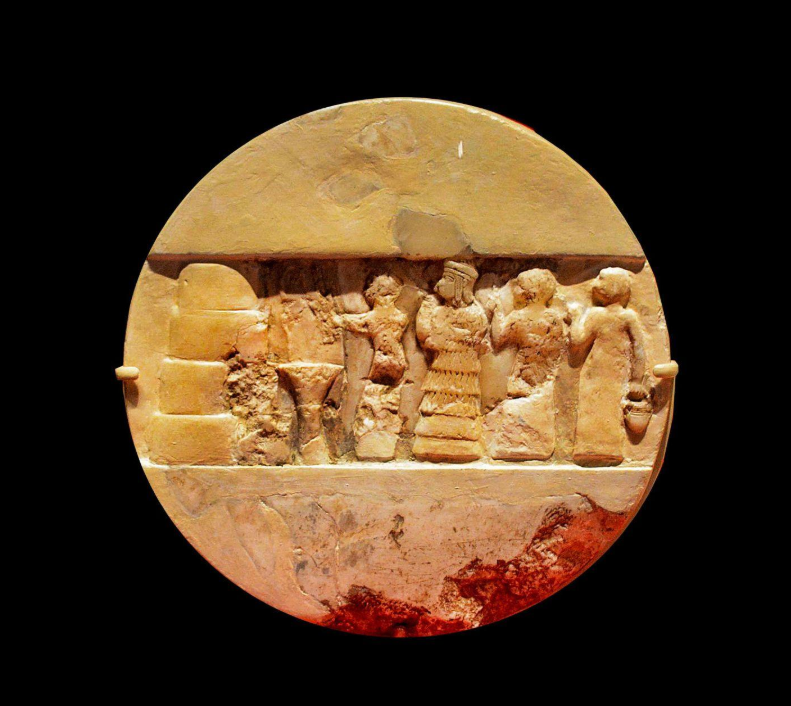
Enheduanna, the first known named author, and the woman whose words survived more than four thousand years.
Before Homer.
Before Sappho.
Before the great poets, philosophers, and writers whose names would come to define the ancient world, there was a woman.
Her name was Enheduanna.
More than four thousand years ago, in ancient Mesopotamia, she put her voice into words—and attached her name to them.
Today, Enheduanna is widely regarded as the earliest known named author in recorded history. Not simply the earliest known female author.
The earliest known named author.
And she was a woman.
A Woman at the Beginning of the Written Word
Enheduanna lived during the 23rd century BCE. She was the daughter of Sargon of Akkad and held the powerful religious position of high priestess of the moon god Nanna in the ancient city of Ur.
But the legacy she left behind extends far beyond her title.
Enheduanna is associated with a remarkable body of ancient poetry and hymns, including works devoted to Inanna, the Sumerian goddess closely associated with the later Akkadian goddess Ishtar.
Inanna was no passive deity.
She embodied contradictions that women have carried for millennia.
Love and war.
Beauty and destruction.
Sexuality and sovereignty.
Creation and chaos.
She could desire. She could rage. She could conquer. She could descend into darkness and return transformed.
And thousands of years ago, Enheduanna wrote of her power.
In doing so, she also revealed something of her own.
She Did Not Write From the Sidelines
What makes Enheduanna extraordinary is not simply that words attributed to her survived.
It is that a voice survived.
Her work does not feel like the anonymous recording of history. Within the literary tradition associated with her, we encounter something profoundly human: devotion, fear, displacement, political turmoil, suffering, and the desire for restoration.
In The Exaltation of Inanna, the speaker describes being driven from her sacred position and turns to Inanna in a moment of crisis.
This was not a woman writing safely from a distance.
This was a voice speaking from within upheaval.
A woman calling upon another representation of feminine power when her own position had been threatened.
There is something startlingly modern about that.
Across more than four thousand years, we can still recognize the instinct:
When the world attempts to silence you, speak.
When it removes you from your place, remember who you are.
When your power is questioned, call upon something within you that cannot be taken.
The Woman and the Goddess
Perhaps this is why the relationship between Enheduanna and Inanna remains so compelling.
One was mortal.
One was divine.
But both existed within stories of power.
Inanna was not required to choose between being beautiful and being dangerous. She did not have to surrender her femininity to possess authority. She could embody desire and warfare simultaneously.
She was complicated.
She was contradictory.
She was whole.
And Enheduanna gave language to that power.
There is a thread here that reaches across history—from Inanna to the women who came after her, from ancient goddesses to women whose stories would later be rewritten by those who held the pen.
It is the question of who is permitted to define a powerful woman.
Is she a goddess?
A queen?
A priestess?
A threat?
A monster?
History has often depended on who was telling the story.
Enheduanna reminds us of something essential:
Women were telling stories, too.
From the very beginning.
Her Name Survived
Civilizations disappeared.
Empires collapsed.
Temples became ruins.
Languages changed.
Kings who believed themselves immortal became fragments in history books.
And somehow, across more than four thousand years, her name reached us.
Enheduanna.
There is something profoundly powerful about that survival.
Because throughout history, countless women created, governed, discovered, wrote, painted, fought, healed, and transformed the world without ever receiving the recognition given to the men around them.
Their names disappeared.
Their work was attributed to others.
Their stories were diminished.
Their voices were forgotten.
Enheduanna’s story offers us something rare: a glimpse of a woman standing near the beginning of recorded literature whose identity was not entirely erased.
She reminds us that women were never absent from history.
They were present.
The question is whether history chose to remember them.
The First Voice Was Never Alone
At GORGONE, we return again and again to the women whose stories deserve another telling.
Not because women need to be rewritten into history.
But because they were already there.
Enheduanna was there.
Writing.
Thinking.
Creating.
Calling upon a goddess whose power could not be contained within a single definition.
More than four thousand years later, we are still reading her name.
And perhaps that is the greatest testament to the power of a woman’s voice.
Stone can crumble.
Empires can disappear.
History can attempt to forget.
But sometimes, words survive.
Sometimes, a woman’s voice crosses four thousand years of silence and finds another woman waiting on the other side.
And when we speak her name again, we become part of that survival.
Enheduanna.
She wrote.
She endured.
And she was never alone.
GORGONE | WOMEN WE REMEMBER
For the women history misunderstood.
For the women history diminished.
For the women history tried to forget.
We remember their names.
“The hardest battle is remaining soft in a world that tries to turn us into stone.”
— GORGONE